
Key takeaways
- 1Side sleeping with a pillow between your knees and back sleeping with a pillow under your knees are the two positions most people with lower back pain find easiest.
- 2Stomach sleeping tends to increase the arch in your lower back and twist your neck, so a pillow under the hips or a three-quarter position is a better compromise.
- 3A sagging mattress causes more trouble than the wrong brand, and pillow height matters more than pillow price.
- 4If your back still wakes you up after a couple of weeks of better sleep habits, the cause needs to be evaluated, not just cushioned.
If your lower back hurts the moment you wake up, or you spend half the night shifting around looking for a position that doesn’t ache, you’re not alone. We hear it every week at our Alexandria office. The good news is that small changes to how you lie down, what you lie on and how you get up can make a real difference.
There is no single “perfect” position for everyone. But there are a few that tend to be easiest on an irritated lower back, and a few simple pillow tricks that make them work much better.
Why sleep position matters for your lower back
Your lower back, or lumbar spine, has a gentle inward curve. When you lie down, your muscles relax and your joints, discs and ligaments settle into whatever shape your mattress and body position give them. Hold a twisted or sagging position for six or seven hours, and tissues that were already irritated can feel stiff and sore by morning.
The goal at night is simple: keep the spine close to neutral. Not over-arched, not rounded, not rotated. That lets the muscles actually rest instead of guarding all night. Pillows are the easiest tool you have to get there, and they cost far less than a new mattress.
Best position #1: On your side with a pillow between your knees
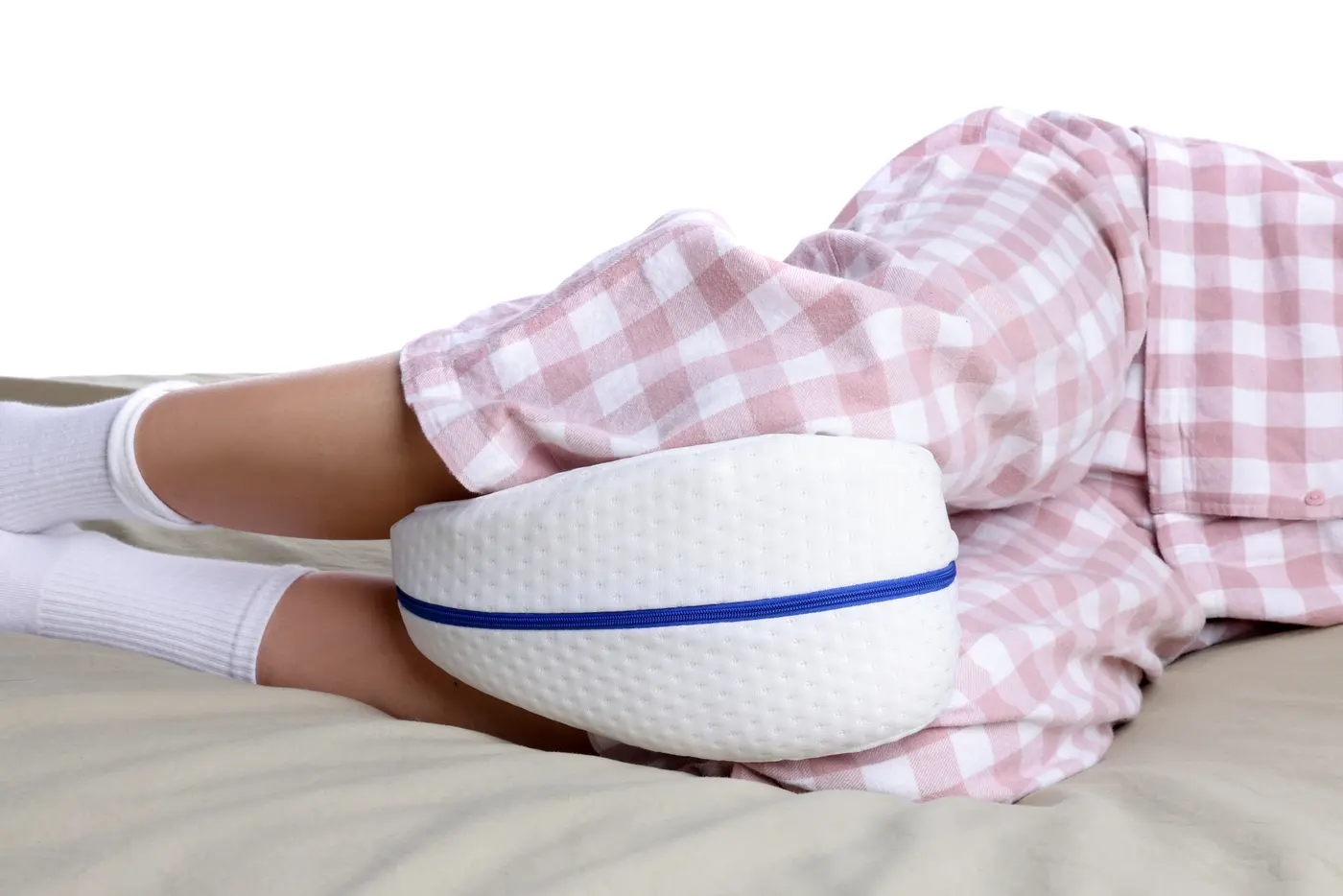
For many people with lower back pain, side sleeping is the most comfortable starting point. The catch is the top leg. When it drops forward and down toward the mattress, it pulls the pelvis into a slight rotation, and that twist travels straight into the lower back.
How to set it up
- Lie on your side with your knees bent slightly toward your chest.
- Place a firm pillow between your knees, and ideally your ankles, so your top leg stays level with your hip.
- Use a head pillow thick enough to keep your neck in line with the rest of your spine.
- If there’s a gap between your waist and the mattress, a small rolled towel there can add support.
Some people with irritated discs find that a slightly curled position eases pressure. Others with joint-related pain prefer their legs straighter. Try both and notice which leaves you less stiff in the morning. Switching sides through the night is fine, and probably good for you.
Best position #2: On your back with a pillow under your knees
Back sleeping spreads your weight across the widest surface of your body and keeps the spine from twisting. For some lower backs, though, lying flat with straight legs pulls the pelvis forward and increases the arch, which can make things ache.
The fix is a pillow, or two, under your knees. Bending the knees slightly lets the lower back relax down toward the mattress. A small rolled towel under the small of your back can help if you like a little more support there. Keep the head pillow on the thinner side so your chin isn’t pushed toward your chest.
Why stomach sleeping is tough on the lower back
Stomach sleeping is the position we hear the most complaints about. Lying face down lets the belly sink into the mattress, which increases the arch in the lower back. You also have to turn your head fully to one side to breathe, so your neck spends the night rotated too.
Habits are hard to break. If you truly can’t fall asleep any other way, try these compromises:
- Put a thin pillow under your hips and lower belly to reduce the sag.
- Use a very thin head pillow, or none at all.
- Try a “three-quarter” position: partly on your side, partly on your stomach, with your top knee bent and resting on a pillow.
Over a few weeks, many people can train themselves toward side sleeping by hugging a long body pillow along their front. It gives you that familiar pressure without the arch.
Mattress and pillow notes
People ask us about mattresses constantly. The honest answer is that comfort is personal, and the best mattress for one back isn’t the best for another. A few general principles do hold up:
- Medium-firm is a reasonable starting point. Very soft mattresses let the hips sink and the spine bow. Very hard ones can create pressure points at the shoulders and hips, especially for side sleepers.
- Sagging is the real enemy. If your mattress has a visible dip or you roll toward the middle, it’s probably no longer supporting you evenly.
- Give a new mattress time. Many companies offer home trial periods. Your body usually needs a few weeks to adjust before you can judge it fairly.
- A topper can be a budget fix for a mattress that feels too firm, but it won’t fix one that sags.
For pillows, height matters more than brand. Side sleepers usually need a thicker pillow to fill the space between shoulder and ear. Back sleepers need less. If your neck is part of the problem, our guide to neck pain from sleeping wrong covers pillow height in more detail.
How to get out of bed without a jolt of pain
For a lot of people with lower back pain, the worst moment of the night is the first one of the morning. Sitting straight up from your back, like a sit-up, loads the lower back at the exact moment it’s stiffest. Try the “log roll” instead:
- Bend your knees and roll onto your side as one unit, keeping your shoulders and hips together.
- Let your legs slide off the edge of the bed.
- As your legs lower, push yourself up with your arms so they do most of the work.
- Sit at the edge for a moment, then stand by pushing through your legs.
Then give yourself a few minutes of easy movement, like walking around the house or taking a warm shower, before you bend to tie your shoes or lift anything. Discs and joints tend to be stiffest right after rest, so the first half hour is when you want to be gentle.
When better sleep habits aren’t enough
Good positioning can ease morning stiffness, but it won’t fix the underlying reason your back hurts. If the pain is still there after a couple of weeks of better pillow habits, or it’s getting worse, it’s worth getting evaluated.
Long days in a chair are a common contributor around here. Plenty of people in Fairfax County sit through a Mixing Bowl commute and then sit all day at work. Our article on lower back pain from sitting covers that side of the problem.
At Franconia Chiropractic Center, a first visit starts with a consultation and exam, with X-rays only when your condition calls for them. From there, care may include chiropractic adjustments, soft tissue work and corrective exercises you can do at home. You can see what’s involved on our services page or read what to expect as a new patient. If anything in your history points to a problem outside our scope, we’ll tell you and refer you.
Most lower back pain responds well to simple changes and the right care, so start with your pillows tonight. This article is for general education and isn’t a diagnosis. If your back keeps waking you up, get evaluated.
Frequently asked questions
What is the best sleeping position for lower back pain?
For most people, it’s either on your side with a pillow between your knees or on your back with a pillow under your knees. Both keep the lower spine close to neutral so the muscles can relax. The best one for you is the one that leaves you least stiff in the morning.
Is it bad to sleep on your stomach with lower back pain?
It isn’t dangerous, but it’s often uncomfortable. Lying face down lets your belly sink, which increases the arch in your lower back, and it forces your neck to turn to one side all night. If you can’t give it up, put a thin pillow under your hips and use a very thin head pillow.
Should I get a firm or soft mattress for lower back pain?
There’s no single right answer, but a medium-firm mattress is a reasonable starting point for many people. Very soft mattresses let the hips sink, while very hard ones can create pressure points. A sagging mattress is usually a bigger problem than firmness.
Why does my lower back hurt in the morning but feel better later?
Joints, discs and muscles tend to stiffen during hours of rest, and movement loosens them up. Your mattress or sleep position can add to it. If long-lasting morning stiffness shows up every day, especially in a younger adult, mention it at your exam, because some inflammatory conditions behave this way.
Can a chiropractor help with lower back pain that keeps me up at night?
Many patients find that chiropractic adjustments, soft tissue work and corrective exercises help with mechanical lower back pain, which often improves sleep too. Pain that is severe and constant at night no matter how you lie, though, should be checked by a medical doctor first.