
Key takeaways
- 1Many herniated discs improve with conservative care, and disc material can shrink over time as the body reabsorbs it.
- 2Chiropractic care for a disc should be gentle and matched to your exam, and it often uses low-force or non-thrust techniques rather than forceful twisting.
- 3Exercise and daily habit changes are a core part of disc recovery, not an optional extra.
- 4Progressive weakness, foot drop, or bladder and bowel changes require prompt medical or surgical evaluation.
Hearing the words “herniated disc” can be unsettling. Many people immediately picture surgery or a lifetime of back trouble. The reality is more encouraging: a large share of disc problems improve with conservative care. The key is making sure the care is gentle, matched to your exam, and paired with a plan you can follow at home. Here’s what that looks like when you see a herniated disc chiropractor at our Alexandria office.
What a herniated disc actually is
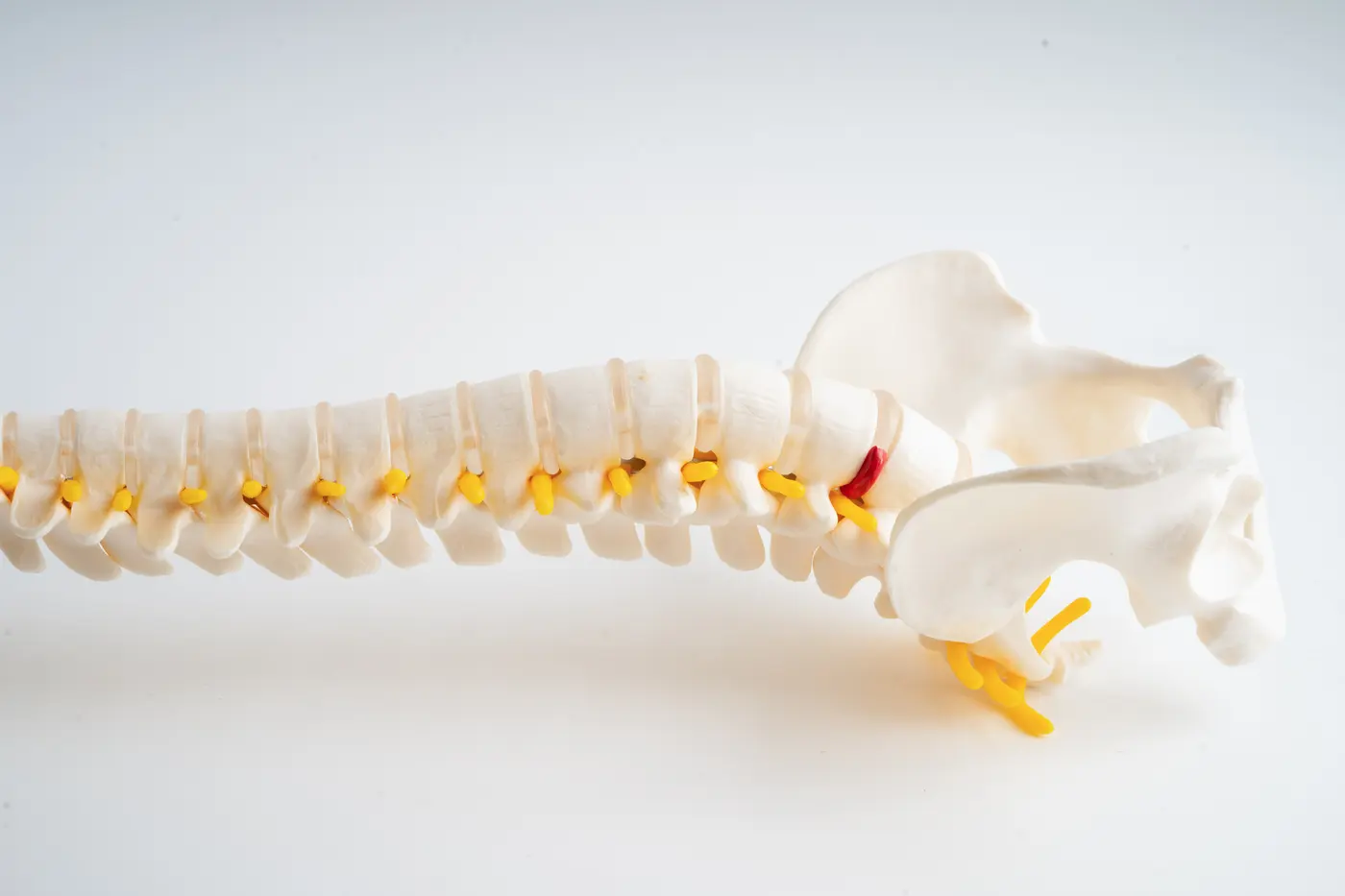
Between each pair of vertebrae sits a disc with a tough outer ring and a softer center. With wear, strain or injury, the outer ring can weaken and the inner material can bulge or push through. You’ll hear several terms for this, including bulge, protrusion, herniation and slipped disc. They describe different degrees of the same general process.
A disc herniation causes trouble in two main ways. It can press on a nearby nerve root, and it can release chemicals that inflame it. That’s why a disc in the lower back can produce pain, numbness or weakness down the leg, which is the classic picture of sciatica.
Disc findings don’t always mean pain
Disc bulges are common on MRI scans of people who have no back pain at all. That’s an important point. An imaging finding has to match your symptoms and exam before it’s blamed for your pain. It’s one reason we put so much weight on a careful hands-on evaluation.
Lower back and neck discs
Most lumbar disc herniations happen at the bottom two levels of the spine, which carry the most load. Discs in the neck can herniate too, sending pain, numbness or tingling into the shoulder, arm or hand instead of the leg. The same principles apply to both: confirm the source, protect the nerve, and restore movement gradually. Neck-related arm symptoms are covered in our article on a pinched nerve in the neck.
Is chiropractic care safe for a herniated disc?
For most people, gentle chiropractic care is a reasonable conservative option once serious problems have been ruled out. The word that matters is gentle. A disc that is irritating a nerve doesn’t need to be forced, twisted hard or cracked repeatedly. It needs pressure reduced and movement restored gradually.
That’s why the exam comes first. Dr. Shaan checks reflexes, strength, sensation and nerve tension, and looks at which movements ease or aggravate your symptoms. X-rays are used only when your condition calls for them, and if your findings suggest an MRI or a surgical opinion is needed, we say so. You can read more about safety in general in our article on whether chiropractic is safe.
What chiropractic care for a disc looks like
No two disc cases are identical, but a typical plan blends several approaches. Care generally moves through relief care, then corrective care, then wellness care as you improve.
Low-force and non-thrust techniques
Many chiropractors use gentle, non-thrust methods for disc patients. One example is flexion-distraction, where a specialized table slowly and rhythmically flexes and decompresses the lower spine while the chiropractor guides the motion by hand. Other options include gentle mobilization and instrument-assisted or low-force adjusting. The specific technique is chosen for your exam and comfort, and nothing is done without your consent.
Directional exercise
Many disc patients have a direction of movement that eases their leg symptoms. For some it’s gentle back extension; for others it’s the opposite. Finding that direction and using it at home is one of the most useful parts of early care. Later, exercise shifts toward strengthening the trunk and hips so your spine handles daily loads better.
Soft tissue work and pacing
Muscles around an irritated disc often tighten protectively. Massage and soft tissue work can ease that guarding. We also help you pace activity, because sitting for long stretches and repeated bending are common disc aggravators.
Habits that help a disc settle down
- Break up sitting every 20 to 30 minutes, and use a small lumbar support on long drives
- Hinge at the hips and keep loads close to your body when you lift
- Avoid repeated forward bending first thing in the morning, when discs tend to be more sensitive
- Walk regularly, starting with short, comfortable distances
- Get support for sleep positions that ease pain; see our guide to the best sleeping position for lower back pain
Common mistakes during a disc flare
- Spending days in bed, which tends to leave you stiffer and weaker
- Pushing through stretches that send pain further down the leg
- Testing the back with heavy lifting or yard work as soon as pain eases
- Stopping your home exercises the moment you feel better, before strength has returned
When a surgery consult is the right call
Surgery has a clear place in disc care, and we refer when it’s indicated. Situations where a surgical opinion is typically recommended include:
- Cauda equina symptoms such as bladder or bowel changes or saddle numbness, which are an emergency
- Significant leg weakness, or weakness that is getting worse
- Severe leg pain that hasn’t meaningfully improved after an appropriate trial of conservative care
- Pain that is so intense you can’t function despite medical pain management
Seeing a surgeon doesn’t automatically mean having surgery. Many surgeons recommend continued conservative care when it’s safe to do so. When needed, we coordinate with your primary care physician, a pain management specialist or a spine surgeon so your care stays connected.
What to expect over time
Many people with a herniated disc notice meaningful change within the first several weeks, with continued improvement over a few months. Disc material can shrink over time as the body reabsorbs it, which is part of why conservative care works for so many patients. Leg pain usually improves before numbness, and strength can take the longest to return.
We track concrete markers at each stage, including how far down your leg symptoms reach, how long you can sit or walk, and how your strength and reflexes test. If progress stalls, we change the plan or refer. Once you’re feeling better, wellness care and your home exercises help keep the gains you’ve made.
If you live in Kingstowne, Springfield, Lorton or nearby and you’ve been told you have a disc problem, reach out to our office to set up an evaluation. This article is for general education and isn’t a diagnosis. If you’re in pain, get evaluated.
Frequently asked questions
Is it safe to see a chiropractor for a herniated disc?
For most people with a disc problem, gentle chiropractic care is a reasonable conservative option once a proper exam has ruled out red flags. Techniques should be chosen for your specific findings, and forceful rotation is often avoided early on. If the exam suggests nerve compression that needs a surgeon, we refer you.
Can a chiropractor put a herniated disc back in place?
No. A disc isn’t something that pops out and gets pushed back in. Care aims to reduce pressure and irritation around the nerve, improve how the spine moves, and give the disc the conditions it needs to settle down over time.
What is flexion-distraction?
Flexion-distraction is a gentle, non-thrust technique performed on a special table that slowly and rhythmically flexes and decompresses the lower spine. Many chiropractors use it for disc-related pain because it doesn’t involve a quick thrust. Whether it’s right for you depends on your exam.
How long does a herniated disc take to heal?
Many people notice meaningful improvement over several weeks, and continued gains over a few months. Some disc herniations shrink on their own over time. Recovery varies with the size and location of the herniation, your health and how consistently you follow your home plan.
When does a herniated disc need surgery?
Surgery is usually considered for cauda equina syndrome, which is an emergency, for significant or progressive weakness, or when severe leg pain hasn’t improved after an appropriate period of conservative care. A spine surgeon makes that call with you, often with MRI findings to guide the decision.